Fubon

Fubon Securities

How e-Counter Unified Fubon's Fragmented Digital Experience

Fubon Securities

Confidentiality: To honor commercial confidentiality obligations with Fubon Securities, sensitive business logic and genuine financial data are absent from this showcase. The following narrative serves to illustrate general structural concepts and strategic project insights.

At a glance

Statement

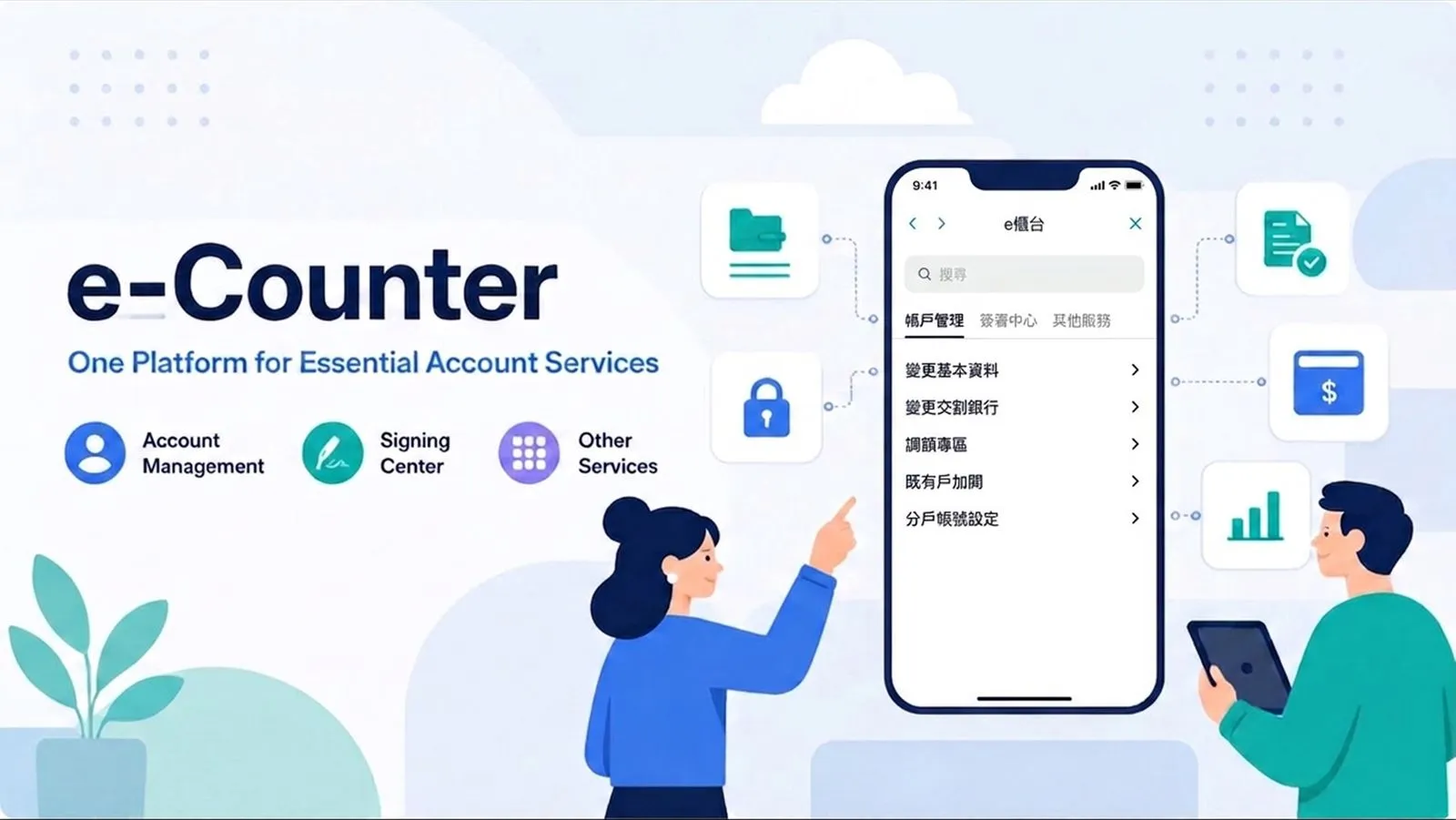
I led the e-Counter project to consolidate scattered non-trading features into a centralized hub, resolving fragmented user experiences and mitigating operational risks.

Strategy

I aligned over 70 stakeholders, standardized the API architecture, and implemented new collaboration models to streamline cross-functional UX and technical workflows.

Result

The project was delivered over 10% ahead of schedule, unifying the digital architecture and significantly enhancing overall customer satisfaction and usability.

Statement

In late 2024, to support strategic business objectives, I was assigned to lead a newly initiated project: to build a sub-feature named "e-Counter" with a strict mandate to launch within one year. The mission was to "consolidate all non-trading functionalities into a single, centralized hub to empower customer service representatives in assisting clients."

Due to evolving financial regulations and rapid business growth, features managed by various business and IT units had become scattered across the platform. This fragmentation made it increasingly difficult for clients (investors) to locate non-trading functions.

Stepping into this role as a dual-hatted Project Manager (with managerial responsibilities) and UX Lead, I immediately identified two major organizational complexities:

  • (1) Complex Cross-Functional Alignment: Features were historically managed across diverse business units, requiring significant effort to align various stakeholders and re-establish ownership.
  • (2) Technical Inconsistency: Development architectures and methodologies varied across engineering teams. We had to account for data validation and credentialing across multiple devices and trading platforms to determine the feasibility of adopting a Zero Trust login architecture.

With over 10 distinct features involved and a substantial active user base spanning our retail client segment, the lack of a cohesive user journey was a critical issue. The friction experienced by frustrated users and stressed customer support teams posed a tangible business risk.

Therefore, my core mandate over the following year was navigating intense time constraints to map out cross-functional points of contact, build synergy between business and tech teams, and establish a unified technical and validation framework.

Strategy

I implemented a "3R" strategy to align the organization and standardize the technical framework:

Strategy 1
Redefine
I collaborated with over 70 stakeholders, including department heads from Business, Digital Finance, and IT, as well as multiple external vendors. For orphaned features lacking clear ownership, I renegotiated collaboration models with senior leadership. By acting as the central project orchestrator, I provided comprehensive support that significantly improved cross-functional communication efficiency.
Strategy 2
Rebuild
I deconstructed complex technical dependencies involving login credential validation, trading platforms, account business types, and diverse embedded web integrations. Guiding our engineering partners, we designed and implemented a unified API integration architecture and design system. This ensured standardized specifications, system reliability, and a seamless digital experience for all future developments.
Strategy 3
Renew
Observing the complexities of our team's division of labor, I applied Tesler’s Law (The Law of Conservation of Complexity) from UX principles to streamline requirement scoping with business units and build strong working relationships with the engineering teams. To ensure long-term scalability, I mapped out standardized project collaboration workflows and defined role responsibilities at each stage, empowering future feature owners to seamlessly onboard and navigate the process.
Result
Result 1
Team Alignment
Successfully aligned a cross-functional project team of over 70+ members, accelerating the project completion timeline by over 10% ahead of schedule.
Result 2
Data Integration Consistency
Comprehensively addressed user and internal team use cases, establishing an optimal and reliable data transmission experience.
Result 3
Effective Consolidation
Received strong positive feedback from frontline staff indicating high client satisfaction and a significant increase in overall platform convenience.
Result 4
Architectural Standardization
Unified the structural architecture and UI design across dozens of disparate features, dramatically enhancing the digital experience.
Result 5
Cross-Functional Communication
Optimized communication frameworks across nearly 10 internal departments and multiple external vendors, effectively eliminating major operational bottlenecks.